
Al-Bustani (1876-1900)
Dāʾirat al-Maʿārif
(دائرة المعارف - Encyclopedia of Knowledge) was the work
of the Lebanese scholar, writer, lexicographer, and
educator
Buṭrus al-Bustānī
(بطرس البستاني, 1819–1883). Born into a Maronite Christian
family in Dibbiyeh, Lebanon, al-Bustānī was a prominent
figure in the
Nahḍa
(النهضة - Arab Renaissance), a nineteenth-century
movement of intellectual and cultural revival in the
Arabic-speaking world. He advocated secular education,
religious tolerance, and the dissemination of modern
scientific knowledge in Arabic.
Widely regarded as the first modern general-purpose
Arabic encyclopedia, Dāʾirat al-Maʿārif was modeled on
European encyclopedias and covered a broad range of
subjects, including history, geography, literature,
science, and technology. Work began in 1875, and the
first volume appeared in 1876. Six volumes were
published during al-Bustānī's lifetime. His family
continued the project after his death, publishing eleven
volumes by 1900, although the encyclopedia remained
unfinished.
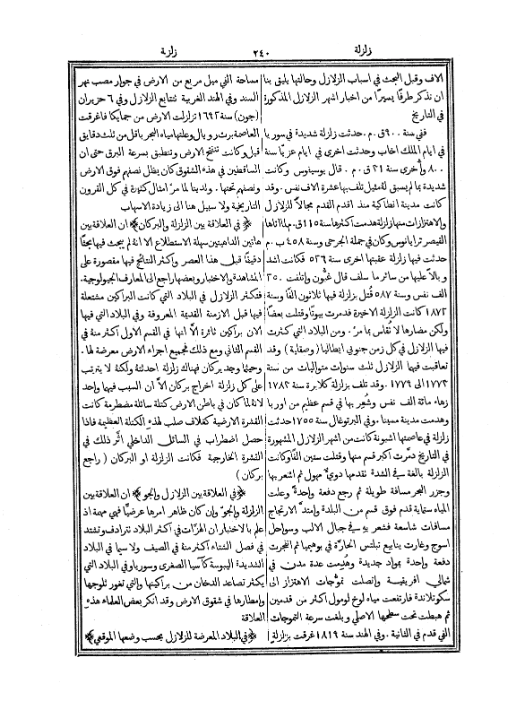
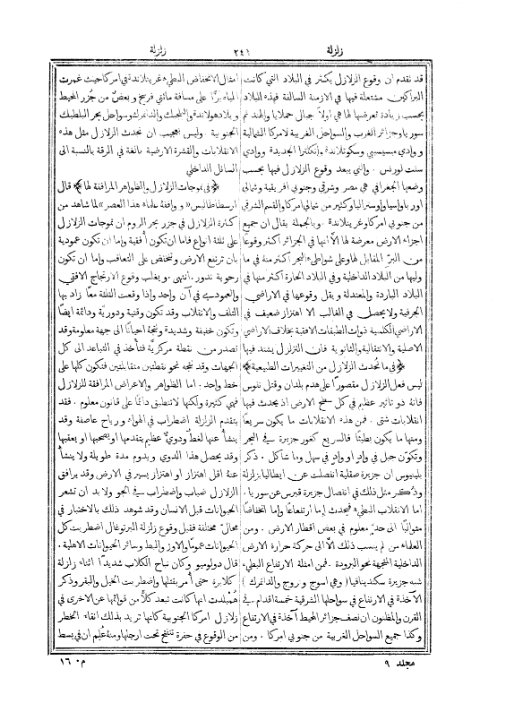
Volume 9, published in Beirut in 1887, contains an
entry entitled Zalzala (زلزلة - Earthquake), beginning
on p. 239. This volume was cited by
Sbeinati et al. (2005),
who drew upon its compilation of historical earthquake
accounts in their study of the historical seismicity
of Syria.
Zalal
242
An earthquake of 240,000 square miles of land near the
mouth of a river, and before delving into the causes and
nature of earthquakes, it is fitting that we mention a
small portion of the news of the most famous earthquakes
mentioned in Sindh and in western India. Earthquakes
continue to occur, and on June 6, 1692, the earth shook in
Jamaica, plunging it into history.
In the year 0 BC, a severe earthquake struck Antioch, the
capital of Syria, and the sea rose in less than a third of
a minute during the reign of King Ahab. Another earthquake
occurred during the reign of Uzziah a year earlier, and
the earth opened and closed with lightning speed, so much
so that 800 people were buried beneath it. Another
earthquake occurred in 21 BC. Josephus said that half of
those who fell into these fissures remained above ground,
and that it was so violent that it claimed ten thousand
lives. We have many similar examples throughout the ages.
Antioch has been a site of historical earthquakes since
ancient times, and there is no way to elaborate further
here. Among the tremors was an earthquake that destroyed
most of the city in 15 BC. Regarding the relationship
between earthquakes and volcanoes, there is a connection
between Emperor Trajan, who was among the injured, and
the year 458 BC. These two calamities are easy to explore,
but they were not thoroughly investigated. An earthquake
occurred there, followed by another in the year 526,
which was more severe than those before this era, and
most of its effects were limited to its destruction, more
so than all that preceded it. Ghubun said, "It destroyed
350,000 lives." Observations and tests, some of which
relate to geological knowledge, show that in the year
587, an earthquake killed 30,000 people. Earthquakes are
frequent in countries where volcanoes were active. The
last earthquake occurred in 1872, destroying houses and
killing some people before known ancient times, and in
countries where they exist, but their damage is not
comparable to what has been mentioned. Among the countries
that now have many active volcanoes, but they are more
frequent in the first part than in the second part.
Earthquakes occur in every era, especially in southern
Italy (and Sicily). Nevertheless, all parts of the earth
are exposed to them. Earthquakes struck for three
consecutive years, from 1772 to 1779. Wherever a volcano
was found, an earthquake triggered it, but this was not
necessarily the case. The earthquake of Calabria in 1783
destroyed approximately one hundred thousand lives and
was felt in a large part of Europe because it was a
molten, turbulent mass within the earth. It destroyed
the city of Messina. In Portugal in 1755, the Earth's
crust, acting as a solid shell for this great mass,
experienced an earthquake in its capital, Lisbon. This
earthquake, one of the most famous in history, caused a
disturbance in the internal fluid, destroying a large
part of the city and killing sixty thousand people.
The outer crust was affected, resulting in an earthquake
or volcanic eruption (see "Earthquake: Extremely Intense,
We Present It as a Terrifying Loud Sound, Then a Volcanic
Eruption Was Felt"). The sea receded a long distance,
then suddenly surged back up, and the tremors rose six
hundred feet above a section of the town. The earthquake
and the atmosphere, though seemingly accidental, are
significant because they spread over vast distances and
were felt in the Alps and along the coasts. It was
learned through experience that tremors in most countries
tend to be frequent and intense. The Teplitz hot springs
in Bohemia dried up and then erupted more frequently in
winter than in summer, especially in countries with very
dry conditions, such as Asia Minor and Syria, and in
countries in North Africa. The ripples of vibration,
where smoke frequently rises from its volcanoes and its
snow melts – Scotland – caused the waters of Loch Lomol
to rise more than two feet and rainwater to seep into
the earth's fissures. Some scientists have denied this,
but then the water sank below its original surface, and
the speed of the ripples reached two thousand feet per
second. In India in 1819, it was submerged by an
earthquake (in earthquake-prone countries, according to
their location).
Zalal
243
It has been mentioned that earthquakes are more frequent
in countries that experienced slow subsidence, such as
Greenland in America, where volcanoes were once active.
These countries are surrounded by water at a distance of
two leagues, and some of the islands of the ocean,
according to their increased exposure to earthquakes,
are first the Himalayas and India, then Holland, Belgium,
Denmark, the coasts of the Baltic Sea, Syria, the islands
of the west, and the western coasts of North and South
America. It is not surprising that earthquakes like these
occur in the Mississippi Valley, Scotland, New England,
the Inversion Valley, and the Earth's crust, which is
very thin compared to St. George's. The occurrence of
earthquakes in these areas is determined by their
internal fluidity and geographical location, such as
Egypt, eastern and southern Africa, and northern Europe,
with its seismic waves and accompanying phenomena.
Aristotle said this, and the scientists of this era
agreed with him, based on what he observed in southern
America and Greenland. In summary, it is said that the
abundance of earthquakes in the islands of the
Mediterranean Sea is due to the fact that earthquake
waves are common in parts of the earth, but in Algeria
they occur more frequently in three types: either they
are horizontal, or they are vertical from the opposite
mainland and on the seashores more than in the areas
where the land rises and is settled in succession, or
they are from the interior countries and in hot
countries more than in the areas where it is rotating.
End. Horizontal tremors are more common in cold and
temperate countries, and less frequent in lands with
vertical tremors occurring simultaneously. If all three
occur together, the erosion increases, and usually only
a weak shaking occurs, causing damage and upheaval.
These tremors may be temporary, periodic, or permanent.
They are also common in calcareous lands with horizontal
layers, unlike other types of lands. They can be light
or intense and sometimes point in a known direction.
They may be primary, transitional, or secondary. In
these cases, the tremor intensifies, originating from a
central point and spreading outwards. Earthquakes cause
natural changes in all directions, and they may point
towards two opposite points, all along a single line.
The effects of earthquakes are not limited to destroying
countries and killing people. As for the phenomena and
symptoms accompanying earthquakes, they have a great
impact on the entire Earth's surface where they occur.
They are numerous, but they do not always follow a known
law. They can cause various upheavals. Some of these
upheavals are rapid, preceded by an earthquake, a
disturbance in the air, and stormy winds. Others are
slow. The rapid ones are like the sinking of an island
in the sea, resulting in a great rumbling and a loud
noise that precedes, accompanies, or follows it. A
mountain might be in a valley, or a valley in a plain,
and so on. This noise may occur and last for a long
time, and Pliny mentions that Sicily separated from
Italy due to an earthquake. He also mentions a similar
event in the separation of Cyprus from Syria.
Earthquakes cause fog and disturbance in the air, and
they are bound to be felt. The slow upheaval, on the
other hand, causes either a rise or a fall in the
atmosphere. Animals, in particular, are affected before
humans, and this has been observed experimentally in
successive events to a known extent in some parts of
the world. From various locations, before the
earthquake of Alberto Gallus, all scientists were
disturbed. Some attributed this only to the movement
of the earth's heat towards the cold.Among the examples
of slow rising, Dolomeo said, "The barking of dogs was
so intense during the earthquake in the Scandinavian
Peninsula (which includes Sweden, Norway, and Denmark)
that he ordered them to be killed. The horses and cattle
were agitated." He mentioned that the rising waters on
its eastern coasts were five feet high. In Humboldt,
it was said that they were separating their legs in
the century, and it is believed that half of the islands
of the ocean are rising. The earthquakes of South
America seem to be intended to cast a shadow of danger,
as are all the western coasts of South America. And
from this, it is known that in the expansion.
Al-Bustani, B. (1876-1900). Dāʾirat al-Maʿārif
(دائرة المعارف - Encyclopedia of Knowledge).
Beirut. Qatar National Library.
Al-Bustani, B. (1887). Dāʾirat al-Maʿārif
(دائرة المعارف - Encyclopedia of Knowledge).
Vol. 9. Beirut. Google Books (First Copy).
The relevant entry is Zalzala (زلزلة - Earthquake),
beginning on p. 239.
Al-Bustani, B. (1887). Dāʾirat al-Maʿārif
(دائرة المعارف - Encyclopedia of Knowledge).
Vol. 9. Beirut. Google Books (Second Copy).
The relevant entry is Zalzala (زلزلة - Earthquake),
beginning on p. 239.
Al-Bustani, B., et al. (1876–1900).
Dāʾirat al-Maʿārif
(دائرة المعارف - Encyclopedia of Knowledge).
Vols. 1–11. Prophet's Mosque Library (Aljam3).
- Contains Arabic and English Translation
Al-Bustani, B. (1876). Dāʾirat al-Maʿārif
(دائرة المعارف - Encyclopedia of Knowledge).
Vol. 1. Beirut. Bavarian State Library.
Al-Bustani, B., et al. (1876–1900).
Dāʾirat al-Maʿārif
(دائرة المعارف - Encyclopedia of Knowledge).
National Library of Israel (Catalogue Entry).
Al-Bustani, B. (1887). Zalzala (زلزلة - Earthquake).
Dāʾirat al-Maʿārif
(دائرة المعارف - Encyclopedia of Knowledge).
Vol. 9. Beirut, pp. 239–242.
Google Books (Direct Link to p. 239).
Al-Bustani, B. (1900). Tiba'a (طباعة - Printing).
Dāʾirat al-Maʿārif
(دائرة المعارف - Encyclopedia of Knowledge).
Vol. 11. English translation (2025).
University of Edinburgh Research Portal.